Showing posts with label JNCC. Show all posts

Sunday, September 9, 2012

Part 2: On becoming a Marine Mammal Observer (MMO) and Passive Acoustic Monitor (PAM) operator


Hello again! This is the second blog post, with questions 2 and 3, to answer queries I've had about how to become an MMO/PAM operator. In the previous post I provided some information regarding what type of background, education and experience I think would be helpful to become an MMO/PAM for offshore industrial (and other!) projects. In this post I will address the safety training that is required to work in the offshore environment and what additional mitigation training is required to work as an MMO/PAM operator. 

So, getting straight to the point...here are my responses to questions 2 and 3: 


2) What safety training is required for this work?
  • Depending on where you work you will probably need BOSIET and HUET certifications or some equivalent. BOSIET is the Basic Offshore Induction and Emergency Training course and usually incorporates the HUET (Helicopter Underwater Escape Training). You will also need to get an offshore medical exam, which must be renewed every two years, and proves you are physically fit to work in the offshore environment.


  • BOSIET - This course introduces you to the dangers of the offshore environment and includes sections on sea survival (life jackets, life rafts etc), fire fighting and first aid.
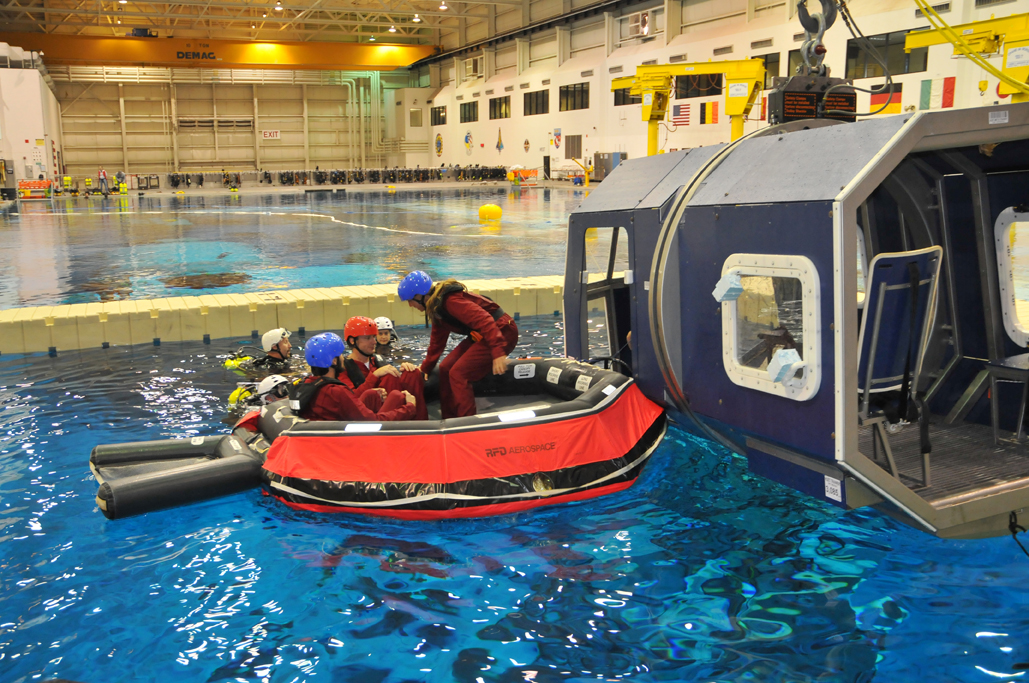
  • HUET - This course is usually included in the BOSIET course. You are trained in helicopter safety and escape because for many jobs crew are a taken to/from the ship by helicopter. The course is conducted in a pool using a model helicopter trainer. You are buckled in the trainer, immersed underwater and must demonstrate the necessary underwater escape skills...even after the helicopter has flipped over!


The helicopter trainer used for HUET courses which just started this year at the Johnson Space Centre, Houston


  • OFFSHORE MEDICAL - This can often be done at the same location as the BOSIET and HUET training but in some places i.e. where I live in Canada, there are only certain places which can provide this certificate. The last time I did this I spent 500$ in one day... 125$ in flights to Vancouver and 375$ to get the medical done!
  • OTHER SAFETY TRAINING - Depending on where you work you might need other safety certifications. For example additional training is required in some countries. 
  • FOET - Once you have your BOSIET you will have to re-certify every four years; this course is called the Further Offshore Emergency Training and only takes one day to complete. The course refreshes you on your HUET, sea survival, fire fighting and first aid. I recently took this renewal course...and was lucky enough to do so at the Johnson Space Centre in Houston! We conducted our pool techniques in the same pool,  which contains a life size replica of the Space Station, the astronauts work in ...very cool!


Happy me...after completing the FOET course at NASA's Johnson Space Center


3) What training for marine mammal and sea turtle mitigation is required?

  • JNCC MARINE MAMMAL OBSERVER (MMO) – This certification is required for any MMOs wishing to work in UK continental shelf waters but is regularly used (often with amendments) in regions around the world without their own guidelines. More information on the courses that are available can be found here and this website provides some more info on what you will learn in the course. 


  • PROTECTED SPECIES OBSERVER (PSO) – To work as an MMO in the Gulf of Mexico you are required to have this certification. This certification can be obtained in a day (often alongside the JNCC MMO certification). More info on PSO courses can be found here.
  • OTHER CERTIFICATIONS – As a start I would recommend getting the above mentioned certifications but, depending on where in the world you are working, you may be required to obtain other certifications specific to the region/country’s legislation, i.e. Canada, New Zealand, Australia, and Brazil have their own set of guidelines.
  • PASSIVE ACOUSTIC MONITOR – In addition to conducting visual observations for marine mammals MMOs are also often certified as PAM operators. PAM systems are used to acoustically detect marine mammals during periods of low visibility i.e. at night, in fog, or in conjunction with visual observations to aid in detection. 


A typical PAM cable deployment and equipment setup on a seismic survey vessel


Conducting a PAM watch...listening for whales and dolphins :)


So that's it for the questions in this post. Once again, I hope you found it useful and if you have any questions or comments feel free to contact me or post! 

Next time I will provide some info on how to get the job once you have all those certifications: 

How do you get a contract and how does working as a freelance MMO work? 

Sunday, December 19, 2010

MMO rotation, offshore Egypt, November/December

MMO job on Ramform Valiant in the offshore Mediterranean waters of Egypt

In early November, after spending nearly a week in Valletta, Malta (see previous post) the vessel left port to travel to Egypt and begin the job I would be working as an MMO on. The transit took about 4 days and then, when we arrived at the site, it took the seismic crew roughly another week to get all the gear deployed. These ships tow hydrophone cables, which can be many kilometers long, and take many days to deploy. The crew must slowly let out the cable from large reels on the ship and it is important to have control of them (there can be up to 14 or more!) so they do not do not entangle...very expensive and time consuming if this mistake is made! 

'Expensive spaghetti' 
What happens if you're not careful! streamer cable entanglement :(

The hydrophone cables are used to record the sounds, created by air-gun arrays also towed behind the ship, that are reflected from the seafloor. Using powerful onboard computers and then further processing onshore they can obtain a 3D image of the seafloor and find the geological structures likely to contain oil and gas deposits or whatever geological features they are interested in. The majority of the time seismic surveys are used for offshore oil and gas exploration but there are occasions when air-gun seismic operations are also used for research on earthquake activity (see post from one of my previous MMO jobs) and understanding unique habitats such as the magmatic structure under underwater deep sea hot thermal vent communities (and another post when I worked as an MMO on one of these surveys).


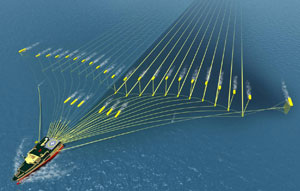
Typical layout for a 3D seismic survey: 
The objects towed directly behind the vessel are the air-guns while further behind are the hydrophone cables
  
Movement of sound from the air-guns towed behind the vessel 
You can see the direction the sound waves move from the air-guns, through the seafloor and back to the hydrophone receivers where the signal travels back to the ships onboard computer processing system


The eastern Mediterranean Sea, known as the Levant Sea, is an area not known to be especially rich in marine mammal activity; this is mostly due to the fact that the Levant Sea has the lowest levels of biological productivity in the Mediterranean (due to poor mixing, high salinity, low oxygen levels in addition to pressures from human activities). Another important consideration, and part of the reason why I was interested in working in this poorly studied region, is that there has been little research conducted in the offshore waters of Egypt. There is one marine mammal research organization, called IMMRAC, which is conducting studies on the marine mammals off coastal Israel. They have done a lot of great work in the coastal waters of Israel contributing to the small body of knowledge on marine mammals in the Levant. Additionally, IMMRAC was the organization to have the first observation of a gray whale in the Mediterranean Sea (and in waters outside of the Pacific Ocean!) since the Atlantic Gray whale was extirpated during whaling in the 1700s) in 2010. Here is a popular media article about this exciting and fascinating sighting.  

Map showing the Levant Sea at the eastern end of the Mediterranean

One marine mammal observer (MMO) was on the vessel throughout this survey; I was on the first five weeks and last month. Even though there were no requirements for us to be present during seismic surveys offshore of Egypt the client chose to have an MMO as a 'best practice' approach and an important part of their HSE (Health, Safety, Environment) policy. Mitigation rules vary depending on the location and requirements of each country. During the survey my role was to look for marine mammals and sea turtles and inform the crew and report on the use of the agreed on mitigation guidelines, in this case the UK's JNCC Guidelines. We would be implementing measures such as a a full 60 minute pre-shooting watch (before the air-guns were turned on), a delay to starting the guns if marine mammals or sea turtles were withing 500 m of the guns, and utilising a 'soft-start' (building the noise level gradually) before starting full production. I also spent as many hours as possible observing for marine mammals and sea turtles during all daylight hours. 

Unfortunately, and as was suspected, I did not have many marine mammal or turtle sightings during my first rotation offshore Egypt. I did have some fun sightings of birds  during the transit and the rotation including many entertaing observations of sparrows, an unidentified hawk and unidentified falcon, a great horned owl and some greater flamingoes. I also had three sightings of dolphins but I was unable them to identify to species level due to their behaviour and distance from the vessel (as you will see in the single photo in this post!). 

In addition to these sightings we also had two sharks attack the gear within the first 24 hours of  deployment! The first attack was relatively benign causing a little damage to one of the 'birds' (used to control the depth movement of the cables) but the second attack resulted in one of the cables being sliced completely in half with the rear end floating away and the chase vessel had to be sent to retrieve it! 

Following are photos taken during transit and my first rotation on this survey:

Some very entertaining Spanish sparrows (Passer hispaniolenses transcapicus)
They were around the vessel for a few days and a great source of entertainment while I was on my visual watches!

Unidentified  hawk sp.?

'Levitating' Spanish sparrown :)


Beautiful sunset

My office

Following three photos: helicopter bringing Egyptian immigration officials


Warbler spp.

Sad but true...this is the only photo of dolphins I got! 
Perfect conditions but not perfect distance and behaviour

My office at sunset :)


Long-eared owl (Asio otus)


More fun(ny) sparrow (house sparrow?) pictures 
Apparently house and Spanish sparrows commonly hybridize making it difficult to confidently ID them, especially during the winter season when their markings are not as distinct


This one was trying to stay on the rail everytime the ship would roll  resulting in the long neck stretch in the following picture - very entertaining to watch!


 And then they discovered the ashtray and proceeded to stick their heads in and try to pull out cigarette butts!


The ABs hard at work painting and making the ship look great!


The moon


An unidentified falcon 
possibly a Peregrine falcon? (Falco peregrinus)

Still can't get sick of the offshore sunsets!

And I saw the 'green flash' when I took these photos


More sparrow shots
Who would've thought they would make such great subjects!


Two of the seismic crew, obviously good friends, enjoying the sunset :)


A not-so-great photo of some greater flamingoes (Phoenicopterus roseus) flying past the ship 

Just prior to the end of the rotation we tried to get into port for our crew change but sandstorms meant we had to wait offshore Port Said for a couple days. The Suez Canal had been closed for a few days so there was a bit of a wait for ship's wanting to get through the canal and into port. Here's the story of the sand storms as reported by BBC.


Finally, we were given a berth in port so headed to shore in Port Said where we did our crew change and went home for Christmas and New Years!