Showing posts with label Africa. Show all posts

Friday, December 27, 2013

December 27, 2013: Angola Flag

365 Project, Day 146
Here is my day 146 submission to my 365Project:

After being away from home nearly 7 weeks I will be on my back to Canada tomorrow! We arrived at anchor early this morning and disembarked the vessel later this afternoon to spend the night in Camp Cabinda before flying out tomorrow. 

While we were at anchor I snapped some photos around the vessel and I thought it was fitting that I got this shot of the Angolan flag our ship was flying as a 'courtesy flag'. 


Fact of the day:
Angola adopted its national flag on November 11, 1975 after it gained independence from Portugal. The red colour in the flag represents the blood shed by Angolans during the national liberation struggle and the defense of the country. The black stands for the continent of Africa while the yellow stands for the mineral wealth of Angola.

Here's our chief officer busily checking on things while the anchor was being set and some other photos while at anchor and in Camp Malongo on shore. 


One of the officers, Norman, doing some fishing on his time off at anchor

On the transfer boat to shore...yipee!

Our first drink in 7 weeks for me and 10 weeks for Aga!


Thursday, December 26, 2013

December 26, 2013: Goodbye Angola Dolphins!

365 Project, Day 145
Here is my day 145 submission to my 365Project:

It's our last day at sea today...production is done and we're just waiting the final recovery of the OBNs (ocean bottom nodes) and for our ship to bunker and take on provisions. I have to admit I wasn't searching for marine mammals today (although I wanted to!) as I was busy doing our end-of-project paperwork of which I wanted to have mostly completed by the time we got to port this afternoon. 

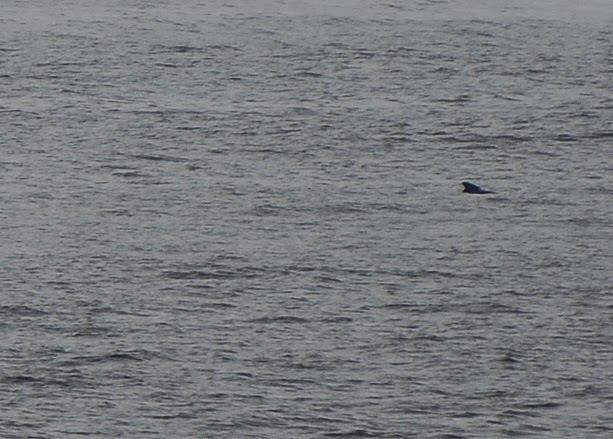
Despite my slacking off in the spotting department ;) we still had a sighting today...thanks to our keen bridge crew. One of the crew called my cabin to ask me if I wanted to see some whales. I thought he was joking for a moment but then he said that there were indeed some animals approaching us off our bow. So, I immediately ran to the bridge and headed out on deck with my camera...and we saw a group of unidentified (but probably bottlenose, Tursiops truncatusdolphins with some short-finned pilot whales (Globicephala macrorhynchus). They didn't come very close, approaching within 2 km at their closest, but I watched them through my binos for about 45 minutes as they busily porpoised and leapt around; a fun sighting and a great way to end our time offshore Angola :)

Despite the distance to the sighting I still managed to get some photos...and here's the best cropped in shot I could get of a leaping dolphin:


Fun fact of the day:
Short-finned pilot whales are commonly observed in mixed species group and are often accompanied by dolphins, especially bottlenose dolphins. In mixed species groups the male pilot whales and dolphins tend to remain at the perimeter of the group. 

Read more about short-finned pilot whales at this Society for Marine Mammalogy webpage.

Here are some more shots from this distant but fun sighting:
Dolphin fun!


Female short-finned pilot whale


Wednesday, December 25, 2013

December 25, 2013: Christmas dolphins!

365 Project, Day 144
Here is my day 144 submission to my 365Project:

All I wanted for Christmas was a Christmas whale or Christmas dolphins...and lucky for me, Santa delivered :)  

While eating my Christmas breakfast with the medic and one of the client reps in the mess room this morning, I glanced out the window and there, to my delight, was a group of dolphins swimming just a few hundred metres off the starboard side of the ship! Of course, I had to  go get a better look and photograph them so I threw down my cutlery and took off to the bridge to grab my camera and binos and check out our Christmas visitors. 

Unfortunately for me, I had a difficult time photographing the group of Common dolphins (Delphinus sp.); my camera was very cold from sitting in the air conditioned bridge so when I went outside it instantly fogged up and, not until the camera and lens matched the ambient temperature outside, could I get any photos despite my many attempts to wipe the moisture off the front of the lens. This was incredibly frustrating especially because I figured out a couple days ago that by keeping my camera in my cabin (in my bed, ha ha!) it would be warm enough to not fog up when I took it out in to the tropical warmth and humidity. Silly me, I had not kept it in my cabin with me last night because today was our last day of production and we hadn't had a sighting for a few days and I didn't really expect we'd have another sighting. Once again I learned my lesson...as is typical with wildlife always plan for the unexpected!  

Here are the best of the shots I could get despite my slightly foggy lens:


Christmas Dolphins! 
You can see the distinct V-shaped dip below the dorsal fin on the dolphin in the middle of the shot...an important feature to use to identify this species.

Fun fact of the day:
Dew Point Temperature is an important thing to know about when shooting in situations with large temperature gradients i.e. the cold air-conditioned bridge of the ship to the warm, humid environment in the tropical outdoors. Dew Point Temperature is the temperature at which humidity (or water vapor) in the air condenses (becomes liquid again) and when you move the camera from one environment to another in which the camera temperature was at or below the Dew Point Temperature  the water vapor in the air condenses on the cold camera creating an annoying fogged up lens.

To read more about Cameras, humidity and condensation check out this The-Digital-Picture.com webpage.


Santa Claus hard at work on the bridge


Our little Christmas tree in the messroom

We even decorated our cabin doors with glowing icicles and all :)

Tuesday, December 24, 2013

December 24, 2013: Christmas Suckling Pig

365 Project, Day 145
Here is my day 145 submission to my 365Project:

Well, it's Christmas eve offshore and, as seems to be tradition on all offshore seismic vessels (this is my third Christmas offshore), the deck and galley crew roasted a suckling pig at the top of the back deck. 

Being somebody who doesn't eat red meat or chicken (I will eat some seafood as it is often the best way to still get some protein while working offshore) I am not usually too excited about the prospect of the roasted suckling pig. Despite this, I will usually go check out the process of roasting the pig... and it still shocks me to see that whole suckling pig roasting on the spit. Don't get me wrong, I fully understand the realities of the 'circle of life' (I have observed many Transient killer whales killing porpoises, seals, sea lion and a minke whale!), but I know that if I had to hunt and kill my own food I'd probably only capable of doing so with fish and I still feel bad when I have to whack a fish on the head or kill a crab to eat it. 

Here's an image I got of one of our Filipino deck crew turning the spit. The guys have to do this for many hours while the pig roasts trading off on spit turning duty the entire time.


Fact of the day:
A suckling pig is a piglet fed on its mother's milk and, in culinary contexts, is slaughtered between two and six weeks. Often, piglets are fed on a liquid diet after they're weaned for up to 10 weeks and then sold as larger suckling pigs. In reality these are 'faux' suckling pigs since they aren't still feeding (or suckling) on their mother's milk.

Read more about suckling pigs at this wiseGeek webpage.

Some more images from the pig roast:


Friday, December 20, 2013

December 20, 2013: Katydid Face Off

365 Project, Day 143
Here is my day 143 submission to my 365Project:

My days on the heli-deck spending hours scanning the water and skies for wildlife can often be a bit solitary but when something, like a little insect, comes along and hangs out with me, I often get pretty excited...which results in me taking lots of photos of such little visitors :) 

Here are some images of a katydid (Family Tettigoniidae) who joined me on the helideck for a couple hours today:


Katydid Face Off!


Fun fact of the day:
In all species of katydid the front wings have special structures that can be rubbed together to make sounds. They hear these sounds with flat patches on their legs that act as ears.

Read more about Katydid's at this BioKIDS webpage.


I loved this series of the katydid's long antenna blowing around in the breeze:


Wednesday, December 18, 2013

December 18, 2013: Jackup Rig

365 Project, Day 142
Here is my day 142 submission to my 365Project:

We're at anchor today just offshore Chevron's camp in Cabinda. There are SO many offshore installations in these waters. Here's a shot I took of a jack-up rig or mobile offshore drilling unit (MODU) as we were transiting to our anchorage early this morning. 


Fact of the day:
Jackup rigs are self elevating. The rig's legs rest on the sea floor and the drilling equipment is jacked up above the water's surface.

Read more about jackup rigs at this RIGZONE webpage.


Tuesday, December 17, 2013

December 17, 2013: On Fire!

365 Project, Day 141
Here is my day 141 submission to my 365Project:

This natural gas flare is still blasting away today...making for another dramatic image of what appears to be the rig on fire. 


Monday, December 16, 2013

December 16, 2013: Orange Moon

365 Project, Day 140
Here is my day 140 submission to my 365Project:

What more is there to say:

"Aim for the moon. If you miss, you may hit a star."

- W. Clement Stone

Orange Moon

It was a bit shocking today to look over at this rig and see what appeared to be a bad fire, but as we were moving along it soon became obvious it only looked this way because of perspective. Really we were just seeing the flames coming off the natural gas flare pipe which they were flaring at full power today.


Sunday, December 15, 2013

December 15, 2013: Halo Tern

365 Project, Day 139
Here is my day 139 submission to my 365Project:

I got this shot of a Royal Tern (Thalasseus maximus) flying past the ship. I did a bit of post-processing in Picasa to add a little enhancement...a lovely halo :)


Saturday, December 14, 2013

December 14, 2031: Offshore Love Message

365 Project, Day 138
Here is my day 138 submission to my 365Project:

Ahhh, love can still be felt from offshore Angola! Today I was photographer for one of our officer's special messages...he got engaged to his girlfriend the last time he was home and now he's been sending her a love message every day until they get married in 2014! 

Here is the message he sent her today! So sweet :) 


This guy is in love with you Maemae!


Some other shots from today...


Rainbow over the Jasper Explorer

BBQ time :)
Here are some more photos from today's love message photo shoot :)


Friday, December 13, 2013

December 13, 2013: Shelf Cloud

365 Project, Day 137
Here is my day 137 submission to my 365Project:

I'm catching up on posting photos (I'm writing this in early February...amazing how fast time goes when life happens :). My photo today is of an offshore cloud formation which I believe is called a shelf cloud, so here's a cloud quote:

"The sky, a perfect empty canvas, offers clouds nonetheless. They shift and drift and beg interpretation...such is the nature of art."

~Jeb Dickerson


Offshore cloud formations...this appears to be a shelf cloud formation

Fun fact of the day:
Shelf clouds are low, horizontal wedge shaped clouds. 

Read more about Shelf Clouds at Accuweather.com

...and the Jasper Explorer with a supply/guard vessel. 


Thursday, December 12, 2013

December 12, 2013: Altocumulus beauty :)

365 Project, Day 137
Here is my day 137 submission to my 365Project:

Okay, I'm way behind on my posts because LIFE happened, ha ha! Actually, we were finishing up the project and I got busy working on our data and writing the report. 

So, It's now well into January and I'm catching up again, eek! Oh well, such is life! Here are some photos from yet another amazing offshore sunset. I absolutely loved how golden the sky was and these altocumulus cloud formations created such an interesting ceiling effect:


Fun fact of the day:
I believe these were Altocumulus clouds. Altocumulus clouds do not usually produce rain but could indicate a weather change in the next day or so (in fact we had light rain the following morning!). 

To read more about altocumulus clouds and other weather formations check out this webpage