Showing posts with label humpback whale. Show all posts

Monday, October 21, 2013

October 21, 2013: L90 Ballena

365 Project, Day 110
Here is my day 110 submission to my 365Project:

Even though I only work occasionally in whale watching in Victoria, I still have many friends working in the industry...which is a good thing for getting out for boat rides when I'm not looking for whales and dolphins offshore and overseas :) This afternoon I went out on King Salmon, Great Pacific Adventures' larger cruising boat. It was good timing to get on the water, especially for this time of year when the weather worsens and things tend to get quieter, because both 'Resident' fish eating killer whales (Orcinus orca) and humpback whales (Megaptera novaengliae) were around. 

After departing the Victoria Harbour we drove south past Race Rocks Ecological Reserve and then along the west coast of Vancouver Island in the Strait of Juan De Fuca to the waters just south of Sooke. We arrived just in time to catch up with the stragglers of the Resident killer whales as they were making their way out west towards the open Pacific Ocean. Although we saw a small group inshore of us we spent most of the brief (but quality) time we had with L90 Ballena a 20 year old female resident killer whale.

L90 Ballena surfacing 
Note: these photos were taken under local whale watch guidelines using a zoom lens and then cropped in.

Interesting fact of the day:
In September 2011 the Centre For Whale Research received multiple reports that L90 was struck by a passing private recreational vessel. Upon hearing this news the staff immediately went out on the water to check on her status. Fortunately, although she was doing very short dives and traveling quite slowly behind the rest of the pod they could see no evidence that she'd been struck by a vessel. Although it was not obvious she was struck there was something troubling about her behaviour.

L90 has been of concern to researchers for a while now. She was always one of my favorite whales as  she is a bit of an underdog often overlooked by both those of us doing the research and those in the whale watching community. She is small for a female whale her age and has an unusual body condition of which we are unsure might indicate illness. Obviously she is still around today, 2 years after this incident, but researchers continue to keep an eye on her. 

To read more on the story of this suspected vessel strike check out these webpages:

  • The Centre For Whale Research's account of L90s Alleged Vessel Strike 
  • This Huffington Post article
  • To see L90 and the rest of the members of her pod in clear photo ID photos check out the Centre For Whale Research L pod ID webpageYou can also become a member and support the fabulous research they have been conducting on this Endangered population since the '70s :)


L90s distinct saddle patch - these are markings researchers use to identify individual killer whales


Race Rocks Ecological Reserve in the October fog

Humpback whale (Megaptera novaeagliae)

If you read my previous post from October 19th you might notice this is the same individual humpback whale, still hanging out near Race Rocks, we observed that day 
Hint...look at the white patches but also notice the dark spot in the white on the left side of the whales fluke


More Steller sea lion (Eumatopia jubatus) action!

Wouldn't want to mess with one of these guys...check out those teeth! Basically they're like bears in the water


Saturday, October 19, 2013

October 19, 2013: Life On The West Coast

365 Project, Day 108
Here is my day 108 submission to my 365Project:

This afternoon I was invited to go on a whale watching trip with my good friend. We've both been working in the whale watching industry out of Victoria for nearly two decades but because we always worked for separate companies we have barely spent much time on the water together. Fortunately, she had enough space on the zodiac she was driving for me to come along for the ride. 

We had a fabulous afternoon watching two different groups of humpback whales (Megaptera novaengliae), a species making a comeback to the waters around southern Vancouver Island. It was such a treat to have, yet again, some more up close and personal observations of these amazing animals!

I got this photo of one of the half dozen animals in the area surfacing with a small recreational fishing boat cruising past in the background and I loved how it really shows how intertwined the humpback whales and the lives of people on the west coast are...this whale was feeding on fish and these fishermen were probably heading in from an afternoon of fishing.


Interesting fact of the day:
Prior to commercial whaling activities on the coast of BC humpback whales were abundant in BC but the intensity of the whaling activities through the early part of last century nearly drove this species to extinction. For nearly 3 decades, sightings of humpback whales were rare in BC water however ongoing studies conducted by researcher up and down the BC coast have revealed they are making a recovery. 

In 1998, my first season working in the whale watching industry in Victoria, I saw one humpback whale briefly and everybody in the industry was incredibly excited. From that time onward sightings of this species has increased every year with re-sights of individuals and even females returning to the area with one or even two calves!

To read more about the recovery of humpback whales around southern Vancouver Island check out this Humpback Whales Making a Splash Off Vancouver Island article

You can also read and download the Fisheries and Oceans Humpback Whale Recovery Strategy at this webpage.

Splashing around!

Humpback whale feeding

Typically the underside of a whale's tail fluke is used for identifying individuals but often the left and/or right dorsal fin shape and any scarring it has can also be used

Tail dive

I love shots with the water flowing off the whale's tail as it dives. Note all the gulls feeding alongside the whale.


These fishermen got a bit of a surprise when the whale surfaced not far from where they were fishing


It's markings like the ones you can see on the underside of this tail fluke that allow researchers to identify and catalogue individual whales


This is one of another group of two whales we observed...notice how the dorsal fin is quite different looking from the other individual


This curious Steller sea lion (Eumatopia jubatus) came quite close to check us out

Sea lion nostrils :)

Saturday, August 31, 2013

August 31, 2013: A Fat Whale

365 Project, Day 68
Here is my day sixty-eight submission to my 365Project:

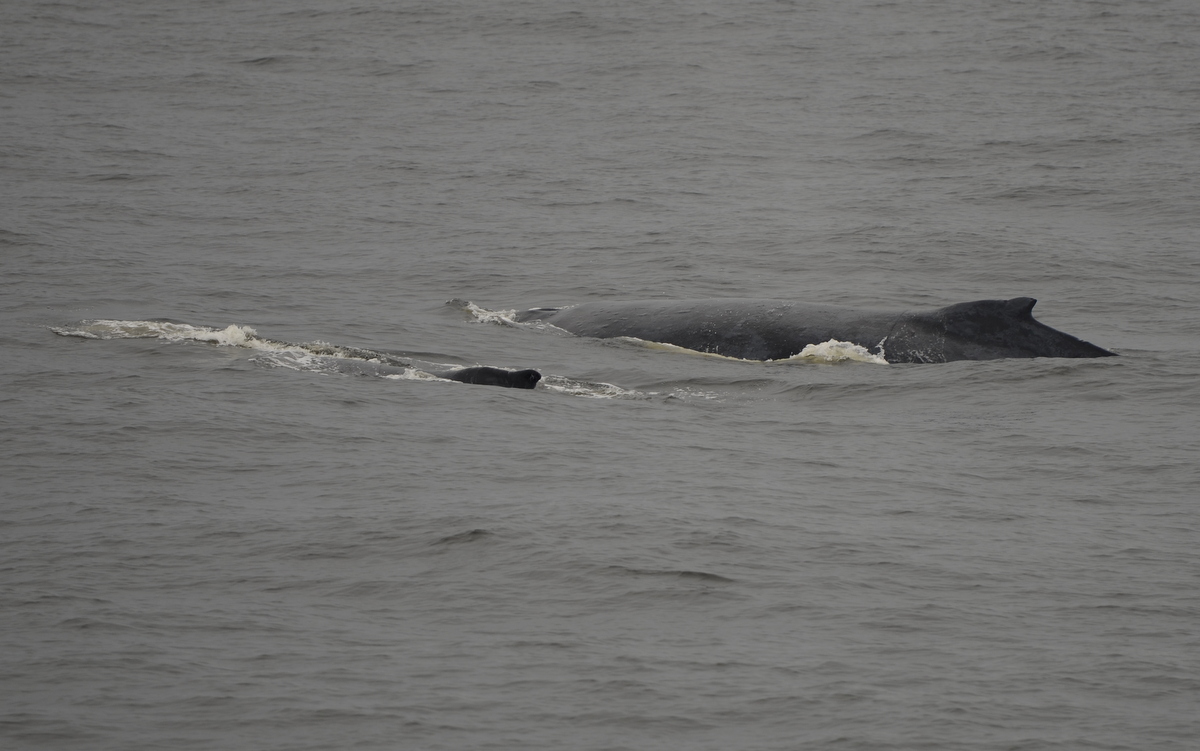
Today was my last day on the vessel offshore Angola...time to go home! Luckily for me, shortly before the helicopter as due to take me to shore (after 10 weeks on the ship!), a pair of humpback whales (Megaptera novaeangliae) swam across our bow nice and slowly. It felt like I was a getting a whale send off and I got this shot of this whale looking pretty fat and healthy from behind :)


Fun fact of the day:
Humpback whales of the southern hemisphere, when in their feeding grounds in the colder, more productive waters of Antarctica, eat tiny crustaceans (mostly krill) and small fish consuming up to 3000 lbs (1360 kg) of food per day. 

To read more on humpback whales check out the NOAA Fisheries webpage on humpback whales. 

  And some more photos from my last sighting on this job:


Saturday, August 24, 2013

August 24, 2013: Rig Art

365 Project, Day 64
Here is my day sixty-three submission to my 365Project:

I've been so fascinated, yet somewhat weirded out, by the busy-ness of the design of these structures. There is just so much going on here...all the pipes!! 


Oh and here are some other photos from today:

A nice close up of a natural gas flare off the same rig...these things light up the offshore night and I've woken up more than once thinking it was early morning when really it was just the lights of all the installations offshore industry!


This humpback whale (Megaptera novaeangliae) surfaced just off our port bow this afternoon. It was rolling at the surface doing pec waves and pec slaps and after I downloaded my photos I noticed something on the whale's back near the tail. After zooming in to the photo (second one below) I realized it had a remora (Family Echeneidae) attached to it and as the whale surface the remora was flung through the air...but remained attached :)


Fun fact of the day:
Remora's likely attach themselves to their hosts for transportation, protection from predators, increased courtship/reproduction potential, enhanced respiration and expanded feeding opportunities. They feed opportunistically on parasitic copepods (most of their diet), zooplankton, small nekton, food scraps from their hosts, and sloughing epidermal tissue and feces of the host.

A couple of years ago on a dive off Zanzibar, Tanzania we had a remora swimming with us the entire dive and it tried many times to attach to myself and the other divers!

To read more about remora and their association with marine mammals check out this pdf.

Friday, August 23, 2013

August 23, 2013: Synchronised Dive

365 Project, Day 63
Here is my day sixty-three submission to my 365Project:

We had an incredibly busy day today...13 sightings of humpback whales (Megaptera novaeangliae) with the majority of them occurring around the same time. In the morning we were trying to track six different groups at once and then, in the afternoon, we were tracking 3 groups at once. It was so busy I barely had time to pick up my camera and take photos! 

These two whales came by quite close so I managed to get a shot of the two of them diving together. You can easily see how different their tail flukes look (one on the left is black, one on the right is white).


Fun fact of the day:
Researchers use photographs of the underside of humpback whale tail flukes to identify and track movements of individual whales and to estimate how many are in a population. Patterns of pigmentation, scarring and shape of flukes are unique to each individual whale. 

You can read more about humpback whale photo-ID and see examples of more photo-ID research at the Fisheries and Oceans Canada Photographic Catalogue of Humpback Whales of British Columbia webpage (my home!).


And here are a few more photos I managed to take while trying to track all these whales:


Wednesday, August 21, 2013

August 21, 2013: A Pair Of Humpbacks

365 Project, Day 61
Here is my day sixty-one submission to my 365Project:

Well, hopefully I'm not posting too many pictures of humpback whales (Megaptera novaeangliae) (ha ha!) but we had 10 sightings of them today so how could I not post more? This pair of whales swam past us today, they were part of a group of five, who all crossed ahead of us with these two passing closest about 100 m off the bow!


Fun fact of the day:
In breeding and calving areas, such as off Angola during the southern hemisphere winter, humpback whale social groups typically consist of a mother/calf and an escort male. Males will escort females in order to mate and fend off other males from mating with the female. 

To read more about humpback whale social groups during the mating season check out Capt Andy's Whale Social Structure & Communication webpage.  


Here are some more images taken while watching this group of whales:


Tuesday, August 20, 2013

August 20, 2013: Whale Nostrils

365 Project, Day 60
Here is my day sixty submission to my 365Project:

This whale calf surfaced just off the bow today and I loved that I managed to get a shot with it's blowholes wide open :)


Fun fact of the day:

Many people don't know this but all baleen whales, i.e. humpbacks, blues, fins etc., have two blowholes while all the toothed whales, i.e. all dolphins, sperm whales, only have one blow hole. 

Read more about the differences between baleen and toothed whales at Whale Trust's webpage About Whales, Dolphins and Porpoises.


Here are some more photos from this sighting:

I loved the look of the water around the whale after the droplets of water from the blow land!