September 11 was the first day after the seismic guns stopped firing and the crew started to recover the Ocean Bottom Seismometers (OBS); the techs send a signal to the OBSs, which are sitting on the seabed, to release them and they take about 30 minutes to drift up to the surface to be picked up. OBS pickup was done over the rest of the next week and for the rest of the survey we no longer monitored the PAM (Passive Acoustic Monitoring) station so our days were shorter.
The first day after the guns stopped firing just happened to be a perfect, flat calm day and when I came up to the tower to begin my morning visual observation shift the two MMOs on watch before me told me that they had seen a group of Dall’s porpoise (Phocoenoides Dalli) and a Leatherback turtle (Dermochelys coriaceae). I didn’t believe them at first but, sure enough, when I went to do my data entry I saw that the sightings had been entered into the spreadsheet. The principal investigators were lucky that these sightings were the day after the guns were turned off because had they occurred the day before we would’ve had to make them shut the guns down. It was such a gorgeous day with perfect spotting conditions that I decided to come up for more time than just my observation shifts. Later on that day we saw a few more Blue Sharks (Prionace glauca) swimming right at the surface near the ship and another couple of groups of Dall’s porpoise.


Above 3 photos: recovering a Woods Hole OBS


Above 3 photos: Dall's porpoise on a flat calm day

Rainbow as seen from the bridge during watch
I was also lucky to celebrate my birthday during this part of the survey. This was my first birthday at sea…and it was a pretty good one thanks to the other crew on board. Many people wished me happy birthday, one of the gunners gave me a nice orange, dark chocolate bar, and one of the Woods Hole techs gave me another chocolate bar. The best part was when I went up to the MMO tower and saw that somebody had decorated it! I found out later that one of the graduate students had gone on the tower after her OBS pickup shift finished at 4 am and decorated the MMO tower while the ship was rolling in the swell in the dark! I had another nice birthday surprise when, although I had wanted a birthday whale, I saw a big male elephant seal (Mirounga angustrirostris) in the water near the ship during one of my watches.

Then, the day after my birthday I got a late birthday present.. a sighting of a new species for me! I was heading up the MMO tower stairs for my morning watch when I spotted a blow off the starboard side of the ship. I saw the blow, which was fairly bushy and not super tall, but not any of the animal’s body. I hollered to John, the MMO going off shift, that there was a whale and he started to make his way back to the tower to check it out too. Unfortunately, when I saw it surface it’s second and last, time he didn’t see it. I saw the back of the animal but not the head and it looked like it had a dorsal fin but it definitely was not a humpback whale (Megaptera novaeangliaea) as I’ve seen many of them and it didn’t look right to be a humpback. After getting over my excitement (yes I was excited!) I described it to the other MMO because I wasn’t too sure what it was. Eventually he told me that it sounded like I saw a sperm whale (Physeter macrocephalus)! I was very excited that I saw my first sperm whale…even though it was only a brief sighting.
We had a few more sightings of porpoise during the last few days of the survey. The weather also picked up just before we headed into port; it wasn’t as bad as the weather we had at the beginning of the survey during the OBS drops; although it was windy (>30 knots) the swell wasn’t as big. Transit day was beautiful and we had some more interesting sightings; 3 fin whales (Balaenoptera physalus), lots of California sea lions (Zalophus californianus), and, another new species for me, a group of Northern Right Whale Dolphins (Lissodelphis borealis). Right whale dolphins are interesting because they don’t have a dorsal fin. Initially I spotted them swimming across our bow and thought they were Dall’s porpoise but they were jumping clear out of the water (which porpoise don't do) so I thought briefly they were Pacific White Sided dolphins (Lagenorhynchus obliquidens) but realised they had no dorsal fin…and that was the defining identifying feature that they were Right whale dolphins!
![]()
![]()
![]()
![]()
![]()
![]()
![]()
![]()
![]()


![]()
![]()
![]()
![]()


![]()
![]()
![]()
![]()
![]()
![]()
![]()
![]()
![]()

The MMO tower with the birthday decorations...a birthday sign (which you can't see so well because it was blowing in the wind!)
Then, the day after my birthday I got a late birthday present.. a sighting of a new species for me! I was heading up the MMO tower stairs for my morning watch when I spotted a blow off the starboard side of the ship. I saw the blow, which was fairly bushy and not super tall, but not any of the animal’s body. I hollered to John, the MMO going off shift, that there was a whale and he started to make his way back to the tower to check it out too. Unfortunately, when I saw it surface it’s second and last, time he didn’t see it. I saw the back of the animal but not the head and it looked like it had a dorsal fin but it definitely was not a humpback whale (Megaptera novaeangliaea) as I’ve seen many of them and it didn’t look right to be a humpback. After getting over my excitement (yes I was excited!) I described it to the other MMO because I wasn’t too sure what it was. Eventually he told me that it sounded like I saw a sperm whale (Physeter macrocephalus)! I was very excited that I saw my first sperm whale…even though it was only a brief sighting.
We had a few more sightings of porpoise during the last few days of the survey. The weather also picked up just before we headed into port; it wasn’t as bad as the weather we had at the beginning of the survey during the OBS drops; although it was windy (>30 knots) the swell wasn’t as big. Transit day was beautiful and we had some more interesting sightings; 3 fin whales (Balaenoptera physalus), lots of California sea lions (Zalophus californianus), and, another new species for me, a group of Northern Right Whale Dolphins (Lissodelphis borealis). Right whale dolphins are interesting because they don’t have a dorsal fin. Initially I spotted them swimming across our bow and thought they were Dall’s porpoise but they were jumping clear out of the water (which porpoise don't do) so I thought briefly they were Pacific White Sided dolphins (Lagenorhynchus obliquidens) but realised they had no dorsal fin…and that was the defining identifying feature that they were Right whale dolphins!

And some not so nice weather approaching us!

Recovering a Scripps OBS


...and then we had some more rough seas

An older Black-Footed Albatross (Phoebastria nigripes) flying near the ship. Older animals get the lighter feathers around the head and tail.

Nicky and my little cabin...mine was the top bunk. What you see is what we had!

Gary and Ricky working their culinary magic at sea in the mess

The mess
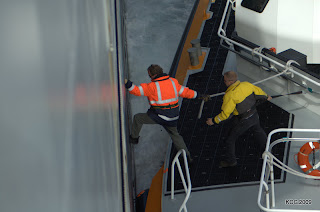
The Pilot boat coming alongside the Langseth to put a pilot to guide us up the Columbia River


The Common Murres (Uria aalge) became more common the closer we got to shore!
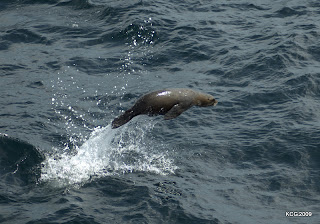
California sea lion in flight!

Gull associating with a sunfish (Mola mola)...gulls are known to associate with sunfish by picking parasite, such as copepods, off their skin (reference referring to this association)
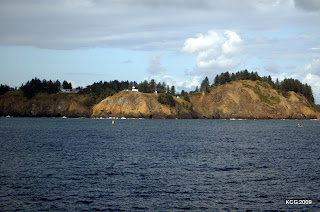
Coming back to land was more interesting than I expected; as we drew closer to shore I noticed there were many seabirds we didn’t see offshore (many species of gulls, common murres, and brown pelicans among others), the sea lions, and the smell of land. The smell of the trees and dirt was so distinct! We finished the survey with a beautiful cruise up the Columbia River back to the fishing boats, roads, bridges, houses and shops and restaurants and pubs. As we were pulling into dock we were also treated to a helicopter rescue display by the US Coast Guard for a fishing festival happening that weekend!


Above 5 photos: Scenery along the Columbia River


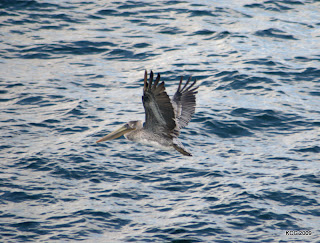
Above 3 photos: Brown pelican fishing in the Columbia River

US Coast Guard Helicopter


Above 4 photos: a crowd greets us at the dock...there was a fishereman's festival at the dock and the US Coast Guard were putting on demonstrations just as we were docking

View from my very comfortable hotel room back onshore!


Above 2 photos: my neighbour on a nest outside the hotel room


